
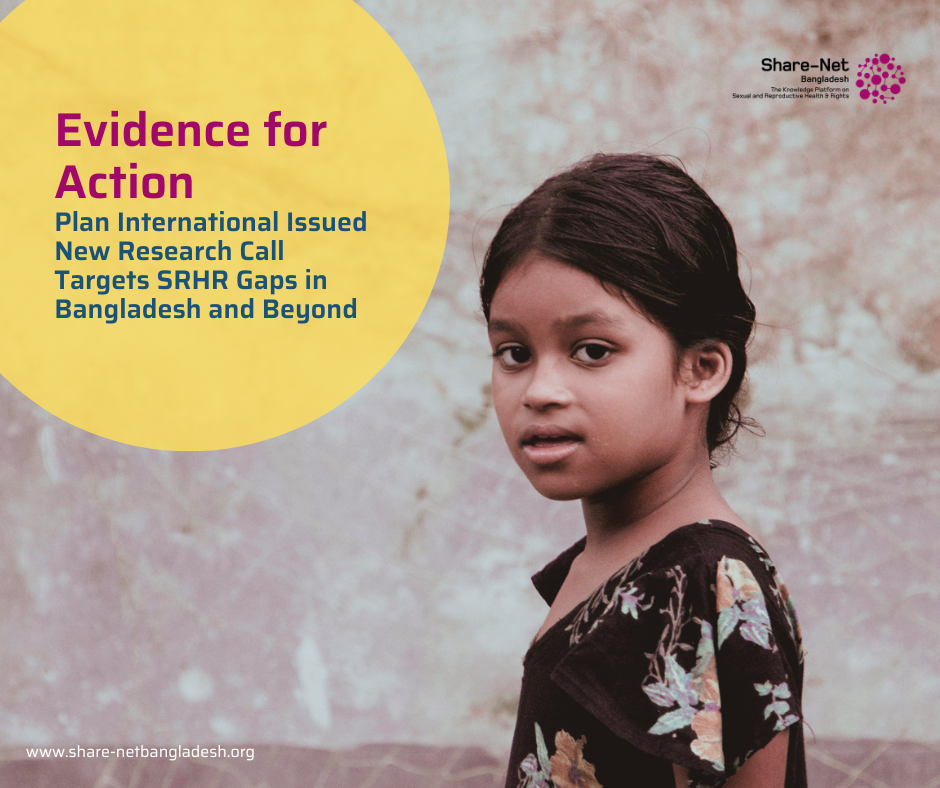
Evidence for Action: Plan International Issued New Research Call Targets SRHR Gaps in Bangladesh and Beyond
What does it take to turn rights into reality for adolescent girls? In many parts of the world—including Bangladesh—the answer still lies somewhere between policy ambition and everyday lived experience. A new global research call by Plan International attempts to close that gap, not by measuring outcomes alone, but by asking a more difficult question: what actually works, for whom, and under what conditions?
Under its Girls Get Equal (2025–2029) programme, Plan International Norway is inviting research partners to lead a large-scale implementation study across seven countries, including Bangladesh. Backed by a NOK 255 million framework agreement with Norad, the programme targets structural challenges such as child, early and forced marriage (CEFMU), early pregnancy, and limited access to sexual and reproductive health and rights (SRHR).
The research is not designed as a traditional impact evaluation. Instead, it focuses on unpacking programme delivery and real-world complexity. As the call states, it aims to generate evidence on “the contribution of selected programme components to intended changes in empowerment, rights realisation, and resilience.” This signals a shift in global SRHR research—from proving success to understanding systems.
This distinction is critical. In Bangladesh, nearly 51% of women aged 20–24 were married before 18, according to UNICEF, while adolescent pregnancy remains a persistent public health concern. Despite improvements in access to reproductive health services, gaps in knowledge, social norms, and service quality continue to limit progress in sexual rights and reproductive rights.
The research will explore four key areas: education, economic empowerment, civil society engagement, and SRHR/CSE (comprehensive sexuality education). Of particular relevance to Bangladesh is the focus on CSE delivery and youth engagement, examining whether adolescents are gaining not just knowledge, but also “protective attitudes” toward their sexual and reproductive health.
Another key innovation is the emphasis on youth as co-creators of research. Rather than treating young people as subjects, the study requires their active involvement in design, data collection, and interpretation. This aligns with a growing body of evidence suggesting that youth-led approaches significantly improve SRHR programme uptake and sustainability.
The methodology itself is deliberately flexible—combining qualitative insights, participatory research, cost-effectiveness analysis, and cross-country comparisons. This reflects an understanding that SRHR challenges are deeply contextual, shaped by culture, gender norms, and economic realities.
However, the initiative also raises important questions. Can implementation research influence policy at scale? Will findings translate into actionable reforms in countries like Bangladesh, where service delivery systems are often overstretched? And how can research avoid becoming an isolated exercise, disconnected from frontline realities?
With a budget ceiling of NOK 4.21 million and a timeline stretching to 2028, the study aims to deliver not just reports, but “actionable findings” for adaptive programming. In a field often criticised for fragmented interventions, this integrated, learning-driven approach could set a new standard.
At a time when global funding for SRHR faces uncertainty, this call is both timely and necessary. Because in the end, improving sexual health and reproductive health is not just about expanding services—it is about understanding people, systems, and the spaces in between. And that kind of understanding can only come from research that listens as much as it measures.
For more details, please visit – ReliefWeb
